
Our return to California was as reluctant as the winter rains in the Amazon. But, as a rule, gypsies cannot stay put in any one place. For the moment, we’re overjoyed to be reunited with our family and friends.
The babies are growing up so fast. Nathan has just completed his first birthday. He’s waddling along perfectly on his two little feet. His days are just packed playing with Parul and Thatha, steering his red tricycle, and furiously pushing his blue walker. Imagine that he walked around Castro Street with us for almost an hour exploring every little nut, bolt, fence, wheel, and pebble he set eyes on. He knows us by our names and identifies us just the way he points out the clock, fan, and Nathan Good Boy. We take with us the picture of him sitting on a high chair at a restaurant during dinner where he gently folds his blanket and put his head on down on the table to indicate that he's tired.
Pushka, as we call our dearest Anoushka, is our darling angel. We miss spending time with her making her laugh incessantly or just plain cuddling her. We picture her sitting on the couch snuggled between two cushions peaceful as a princess or mischievously grinning at us from her bouncer or thoroughly pleased during her bath service. And Trisha, aren’t you growing into a pretty pretty doll. Our favorite moment was when the two little darlings shared the same chair and Trisha cuddled up to her newest friend to hide from mommy’s over-enthusiastic bid to extract a smile.
Despite all these ties, life also feels strange back "home". What makes a place "home"? Friends and family certainly make us feel like we're back. But we really miss going back to our own apartment, which by the way (we went back to check) still remains unoccupied since we left. For once, we land back without stressing about work piling up in the office. But oddly enough that stress breeds familiarity, a sense of arriving back. We’ve traded "home" for our "banjara" existence. And this is probably the first time this reality hit home.
Returning to the United States also disconnects us from our vacation world. The past two months seem like they never happened probably because nothing much has changed back home. Other than the babies, little else has made progress. Is this the way things will feel when we finally stop traveling? It’s a question that buzzes around our minds like an annoying little bee. There’s no doubt that we’ll miss the thrill of moving on every day, at least geographically, and planning our next move.
Not surprisingly then, we fly out of United States barely a week after we return. Our plan is to gather all our visas in India while spending time with our families there. Meanwhile, we’re making a totally unplanned pit-stop in Thailand and Cambodia.
Monday, April 25, 2005

Monday, April 18, 2005
Condors at Colca

Colca canyon is supposed to be the deepest canyon in the world, deeper even than the Grand Canyon. Although it lacks the glamour of its Arizona counterpart, the Colca valley is truly spectacular and renowned for watching condors up, close, and personal.
From Arequipa to Chivay, we made our journey up to a height of 5000 meters in a van stuffed with twelve people. Our guide Cesar was a character. Ever since our travels in Turkey, we've instinctively developed a distrust for all those that start their sentence with "Friends". We just flinched every time Cesar addressed us as "friends". The van had an international flavor to it: French, Chilean, Peruvian, Portuguese, and Brit. On the road we introduced ourselves and talked about what we were hoping to get out of the trip. Nagesh was really eager to see the condors.

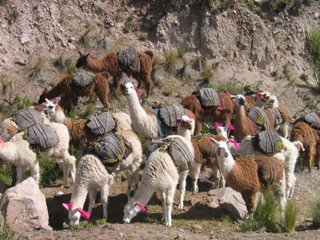
The drive to Chivay - the city of love - meandered through the Andean range with lunar landscapes and volcanic peaks rising upto 6000 meters. We stopped off at several vistas speckled with herds of Llamas, Vicunas, and Alpacas. Alpacas are the cute ones, Vicunas shy and slender whose wool is the finest and most expensive, while the Llamas are known to be the proud brats.
Early in the day our guide lost some of his audience when he got into an argument with a fellow traveler who used the term "Indian" generically to describe native Peruvians. Through the rest of the journey we were sniggering in the back like kids in a classroom whenever Cesar spoke. His favorite pastime was to ask "Senorita Rita" if she had "alguna pregunta" (any question). Enroute we drove past the peak Mismi where the Amazon is born. It's so amazing how a stream of melting ice turns into the mighty Amazon before joining the Atlantic.

At 5000 meters, we were intrigued by unique configurations of tapering rocks stacked on either sides of the highway. As soon as we heard that these piles were built for good luck, we promptly assembled our own little tower. There’s something about this place that we shall carry in our hearts forever. The air at this altitude was thin and crisp. Cesar distributed handfuls of coca leaves to help us along. Some chose to stick it to their foreheads, Nagesh chewed his leaves like paan and swallowed them despite instructions to the contrary from Cesar (he survived!), and Kavita simply tucked hers away in a notebook as a memento of this wonderful trip.
Chivay is a dusty town with little to talk about. Later that afternoon, we headed to the local hot springs set outdoors amidst the splendors of nature. The day came to an end with dinner at a local restaurant accompanied by a traditional dance show.
It was condor country bright and early next morning. We passed several Inca terraces still in use for farming. And then…Colca canyon stretched out beyond our deepest imagination. The Condor cross was swarming not with condors but with tourists perched precariously over the rim for one glimpse of the mighty bird. In the Incan pyramid of life, the condor signifies the highest order, closest to God.
The condor cross structurally creates a wind tunnel conducive to the condor’s flight. But where were the birds? After admiring the emptiness of the canyon for a good half-hour, we were rewarded by the most graceful swoop of a majestic condor. With its wing length spanning a colossal six feet, the bird performed a fly-by to a cheering audience. It's a miracle that Nagesh did not fall into the canyon trying to capture every flap on his camera.

There was something soulful about this experience. We tied up the day with a fifteen minute meditation in worship and quiet contemplation of God's creations.
Sunday, April 17, 2005
Amantani: Back to Basics

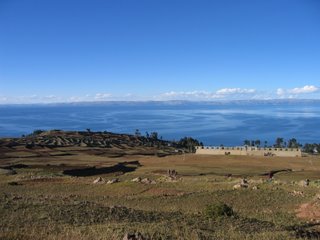
Spectacularly set amidst the indigo blue waters of Lake Titicaca, the rocky and rural island of Amantani seems larger than life. As the boat approaches the docks, Julio prepares us for a meeting with our island "fathers" and "mothers". As part of the true Peruvian experience, a local island family will adopt us for a night.
The fathers and mothers are waiting for us in traditional costumes of colorful ponchos, layered skirts, and embroidered shirts. They step forward to claim us when their names are called out. There seems to be some confusion regarding the pairing but it all works out in the end.
To Kavita’s disappointment, we're escorted "home" by a stiff and tacit father rather than a plump and warm mother like most others. Our home, as our father points out, sits on top of a hill offering stunning views of the lake. But following up the rough terrain at an attitude of 3500 meters is a challenge to our lungs every step of the way.
Our home is a modest two-storey brick hut with a small courtyard. The kitchen is removed from the main house and the bathroom lies completely outside the compound wall. Our room on the first floor is basic but clean and well decorated with Peruvian woven bedspreads. One solitary window overlooks the entire expanse of the lake.
While Nagesh was adjusting to the ultra low roof, Kavita anxiously waited for the mother to arrive and bring us some lunch. But she was nowhere to be seen. Following her curiosity, Kavita tried to peep into the kitchen where a big fat rodent greeted her instead of the lady of the house. Well, so much for our appetite. Minutes later, a short, very stiff looking lady walked by into the kitchen.
Kavita wanted to help out with lunch. Remember those ‘Learn Java in 24 Hours’ guidebooks, well this was our version of "peruvian cultural immersion" in 24 hours. But we should have read ‘Cooking in the Villages for Dummies’ before Kavita ventured into the pitch-black kitchen. Getting the fire started was no mean affair. The firewood smoked up the room causing tears to flow unhindered. So much for ignoring mother’s warnings and over enthusiasm! Smoke, large rodents, and a stern mother were not what we had bargained for.
Anyway, Kavita soon broke the ice (with her broken Spanish) and got chatting with the mother who seemed pleased to find out that we were married and not just dating. She spoke about her two kids who were at school but really had no careers awaiting them on the island. Tourism brings in most of the revenues and the kitchen garden supplies all the vegetables. No meat is cooked on the island.
A few minutes later, feeling left out, Nagesh joined the party. His first impression of the kitchen was rustic. As his pupils adjusted, he saw dark charcoal walls with twigs and dry leaves in one corner and potatoes in another. Kavita was sitting on a platform made of mud. The cooking range was a six-holed multi-tiered earthen cavity. There was water boiling in one pot and some other liquid bubbling on the other. The kitchen grew quiet…umm strange men were not very welcome. We were better off waiting for lunch in our room upstairs.
After an eternity, father arrived with our first course. Quinoa soup. We looked at each other with an oh-no-not-again sigh. This staple Peruvian lentil had been showing up in all our meals for the past ten days. We were getting tired of it. But the thought of mother’s kitchen and all her efforts made us swallow the soup down appreciatively. Our second course was a bowl full of whole boiled potatoes without the slightest taste or salt or spice. Words failed us. As Nagesh attempted a stab at the entrée, Kavita broke down in tears. Overcome by a wave of nostalgia, she regretted all the times she’d given her granny a run around the house, fussing over perfectly delicious home-cooked meals. We worked our way through the hard-boiled tuber meal in emotional silence. Nagesh gulped his food down choking with emotion at the thought of this being the daily diet of our hosts. On a lighter note, eating less would ensure fewer trips to the flush-less toilet outside. For every use of which we had to fill a plastic container with water to manually flush the potty-like contraption.
At five that evening, we met our tour group for a hike up to the temple of pachamama(mother earth). Sniffing munia herbs to ease the effects of altitude, we made it to the peak for a most rewarding sunset.
Later that night, the mother brought us a stack of traditional robes and invited us to a dance party. She helped Kavita into two layers of black and red fluffy woolen skirts secured with an intricately embroidered waistband. A white embroidered shirt completed the ensemble. Nagesh claims he resembled a ‘bahadur’, or a Nepali sherpa, in his poncho and woolen Peruvian cap. Our family also dressed up for the ocassion.

We were escorted to the venue of the party with the help of flashlights. There’s no electricity on the island. At the school auditorium, there was a live band featuring Peruvian flutes and drums ready to set the party rolling. It was exciting to see the entire tour group dressed up. We all blended in perfectly except for those dead give-away hiking boots. What followed was a cornucopia of island revelry. Led by our families, we danced and spun around the room in mad circles. Boy, it takes some effort to jive to local beats at this altitude! As the party got more frantic, the dancing shifted outdoors circling a bonfire. There was not a single pair of feet standing still.

Next morning. Subah ka hai waqt aur dabba haath mein (It's time to potty and he has a container in his hand). It was that time of the day and Nagesh was spotted rushing with a jug of water in hand from the kitchen to you know where!
Lake Titicaca: High Waters

We made our way from Cuzco to Puno in what our travel agent described as the "non-tourist" bus. We later discovered that this meant no AC, no bathrooms in the bus, and hordes of local travelers (most of whom sat themselves along the aisles when the seats got full). It was nearly sunset when we drove along the incredible Peruvian countryside painted with green hills and tiny villages cramped with red roofs. The church is always the tallest building and Incan trapezoidal doors, built as such for good luck, characterize most homes. Plump women in fluffy black embroidered skirts and typical Peruvian hats briskly drive the cattle home. They all have multi-colored shawls strapped across one shoulder lugging everything from children to lambs to handicrafts to vegetables. Little children play outside without a care in the world. Painted on mud walls, ads for Inca Cola and Cusquena beer rush by.
No one announces names of the stops. Nervous about missing ours, we make it a point to ask the locals every time the bus halts and hop off when we reach Puno. We spent the night at a hospedaje run by a most delightful lady who, later, walked us right into downtown in search of dinner and, much later, packed us into bed with hot water bottles. She talked about the harsh weather in Puno, the Quechua people who inhabit the area, and how we’re the first hindu guests she’s proudly hosting.
True to tradition, our tour van collects us next morning and takes us to Lake Titicaca. En route, we stop off to buy fruits, candy, water, and other supplies that are scarce on the islands we’re touring for the next couple of days. Our first view of the highest navigable lake in the world is devoid of any wonder. Looks ordinary enough, except that we’re at an altitude of 3000 meters. Along with Julio, our guide, and fifteen other travelers, we set sail for Uros or the floating islands on this gorgeous day.
We gasp as we spot clusters of golden islands floating on crisp blue waters of the lake. Platforms of reed or tall dried grass support five to seven huts each. Local women greet us in Quechua as we step onto the surprisingly stable 20X20 island. We settle down in a circle on the straw floor while Julio talks about the Uros and its people. A layer of the dried reed is added to the island floor each week to thicken its base and keep the islands dry. The islands themselves last around twenty years after which the families move onto new ones. To ensure that the islands don’t float away to Bolivia, or the "caca" side as Julio jokes, they are hoisted upon firm stakes. It’s almost like a city on water, with floating neighborhoods.
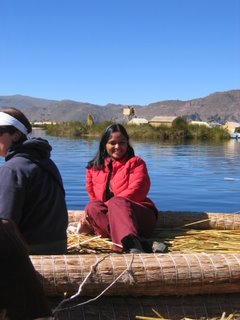
Julio serves us the local snack called the "island banana" which closely resembles a sugar cane but tastes like… well… nothing. Our eyes are drawn towards the poori-like bread that an elderly woman is frying in the open. She uses earthenware for cooking and an earthen stove fired up using … you guessed it… dried reed.
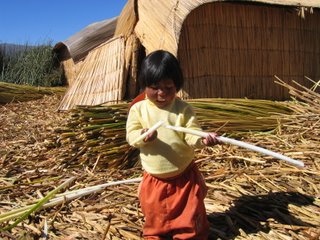
Dotting the surrounding waters are long reed boats in fancy shapes to navigate from one floating island to the other. A dollar a pop transports us to the largest island in the bobbing city. We’d heard that the islands were floating tourist traps with the locals swarming visitors and forcing them to buy handicrafts. To the contrary, we don’t feel harassed at all and thoroughly enjoy the experience.
Nature and people continue to amaze us as we embark on a long three-hour cruise to the volcanic island of Amantani.
Adventures in The Amazon: Day Three
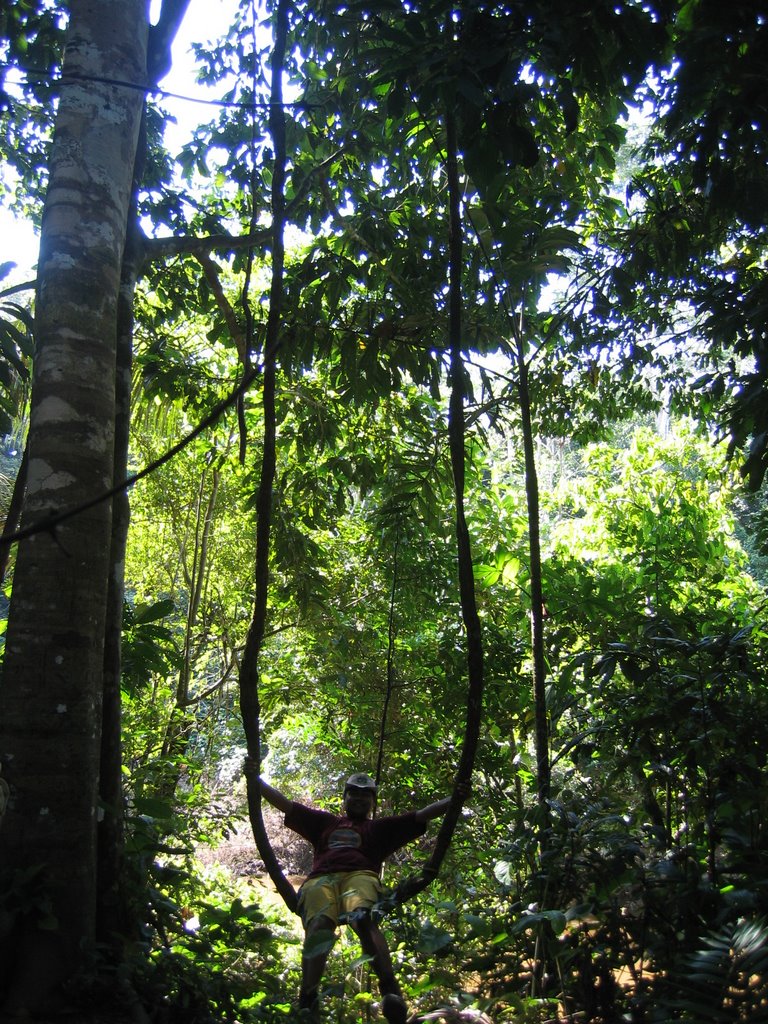
By this time Percy’s commands had become second nature to us, although the Norwegians confessed that they were having a tough time taking orders. The next morning was ripe with ebullient sunshine. We were only too happy to hide away in the forest. Nagesh found a swing in the jungle, a la Tarzan, while Elmer shimmied up a tree to retrieve a green fruit. He then dipped a toothpick into the juices of the "tattoo" fruit before practicing his art on our hands. We looked on incredulously as he etched invisible shapes from the colorless liquid. But exactly as promised, a snake and a flower came alive on each of our hands, taking on jet-black outlines within an hour. Our tattoos lasted ten days.
Fishing was foremost on our agenda this morning. We rowed up the muddy waters of the shallow Gamitana river and anchored the boat under a shady tree. On a nearby boat, a father and daughter team was fishing and washing clothes. Their son, barely seven or eight years old, was standing ashore and expertly throwing in his fishing line. He’d already caught his lunch.
Elmer prepared our fishing rods; pieces of meat tied to hooks fastened to the ends of long wooden sticks. We all threw in our lines and waited in somnolent silence for a tug. Just as we were dozing off on the edge of our boat, Elmer caused a stir. We all stood up in excitement as he pulled up a big catfish struggling helplessly at the end of his line.
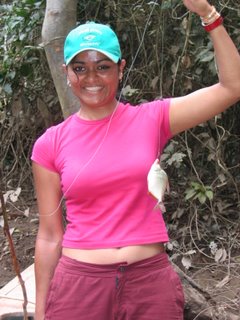
Inspired by his success, Kavita threw in her line in the same direction. She could feel some tugs but nothing each time she pulled up her line. Extreme patience in mind-dulling heat was about to pay off a few minutes later when she heaved out her line showing off a perfect little silver fish. Crazy with excitement, she began jumping up and down, rocking the boat wildly and destroying anyone else's chances of ever landing a catch. Meanwhile Nagesh, who was more concerned about losing the fish, rapidly goaded her to bring the catch into the boat. The ecstatic beginner first posed with her prize before handing it over to Elmer for cleaning.
Percy conducted our last activity that evening walking us around a medicinal garden in the lodge. The plants and shrubs grown here can cure anything from snakebites to altitude sickness.
 Our fantastic hosts : Percy the manager and Elmer our ranger.
Subscribe to:
Posts (Atom)
